
 Home
Home About Us
 Services
 Products
 Activities
 News
News Contact
Why Is Industrial Air Compressor Essential for Beverage Production?
Pressure is one of the most important specifications of any industrial air compressor. It determines how much force compressed air can deliver to production equipment and directly influences system performance. However, higher pressure does not always mean better performance. Every manufacturing process has its own operating pressure requirements. Selecting a compressor with excessive pressure may increase electricity consumption without providing any production benefit. Conversely, insufficient pressure can reduce equipment performance, interrupt production, and affect product quality. For this reason, compressed air systems should always be designed around the actual needs of the production process rather than selecting the highest available pressure.What Is Low Pressure Compressed Air?
A low pressure air compressor is typically designed for applications requiring moderate operating pressure but relatively high airflow. These systems are commonly used for:- Pneumatic conveying
- Wastewater aeration
- Low-pressure drying processes
- Textile production
- Certain packaging applications
- Industrial automation
What Is High Pressure Compressed Air?
A high pressure air compressor delivers compressed air at significantly higher pressures for specialized manufacturing processes. Typical applications include:- PET bottle blowing
- High-pressure testing
- Gas boosting systems
- Industrial molding
- Pressure vessel testing
- Specialty manufacturing
Key note:
Selecting the correct operating pressure improves production efficiency while avoiding unnecessary energy consumption. The objective is to match compressed air pressure to the actual manufacturing process—not simply choose the highest-pressure compressor available.
High Pressure Air Compressor vs. Low Pressure Air Compressor
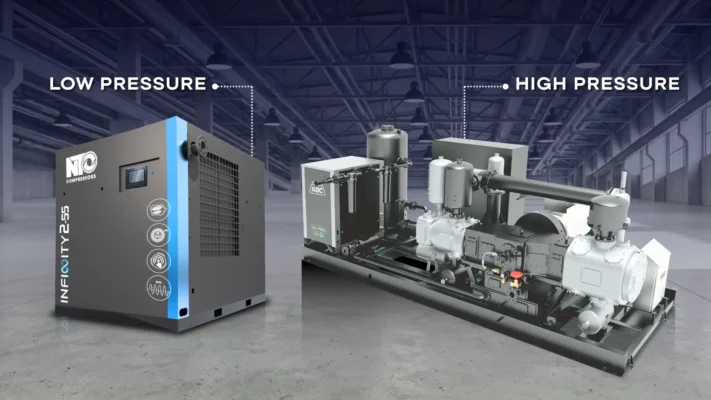
|
Comparison |
High Pressure Air Compressor |
Low Pressure Air Compressor |
|
Operating pressure |
High |
Moderate |
|
Typical airflow |
Medium |
High |
|
Primary application |
Specialized manufacturing |
General industrial processes |
|
Energy demand |
Higher |
Lower |
|
Typical industries |
PET bottle blowing |
Automation, conveying, packaging |
- Production capacity
- Airflow demand
- Future expansion
- Product quality requirements
- Energy efficiency
- Maintenance strategy
- Total Cost of Ownership (TCO)
Pressure Stability Matters More Than Maximum Pressure
One common misconception is that increasing system pressure automatically improves production. In practice, stable pressure is often more valuable than maximum pressure. Pressure fluctuations may result in:- Inconsistent machine performance
- Longer production cycles
- Product quality variations
- Increased energy consumption
- Additional mechanical stress
Key note:
The best compressed air system is not necessarily the one with the highest pressure, but the one that consistently delivers the pressure required by the production process.
Which Industries Require Different Pressure Levels?
Different manufacturing sectors require different compressed air characteristics depending on their production processes.High-pressure applications
High-pressure systems are commonly found in industries such as:- PET bottle manufacturing
- Beverage packaging
- Plastic molding
- Pressure testing
- Specialty manufacturing
Low-pressure applications
Low-pressure systems are widely used in:- Wood processing
- Electronics assembly
- General manufacturing
- Pneumatic conveying
- Factory automation
- Packaging operations
Where Does Oil-Free Compressed Air Fit?
Pressure is only one factor when selecting an industrial air compressor. For industries such as:- Food and beverage
- Pharmaceuticals
- Electronics
- Medical manufacturing
Key note:
The correct compressor selection depends on three factors working together: pressure, airflow, and air quality. Choosing the right balance helps manufacturers improve efficiency while supporting reliable production.
How to Choose the Right Rotary Screw Air Compressors
Among the many compressed air technologies available today, rotary screw air compressors remain the preferred choice for continuous industrial production. Their ability to deliver stable airflow, high reliability, and lower operating costs makes them suitable for factories operating one or multiple shifts. However, selecting the right rotary screw compressor involves much more than comparing power ratings or purchase prices. Manufacturers should evaluate the complete production process and future operational requirements.Match the Compressor to Actual Air Demand
One of the most common mistakes is purchasing a compressor that is significantly larger than current production needs. Oversizing often leads to:- Frequent unload cycles
- Lower energy efficiency
- Higher maintenance requirements
- Increased electricity consumption
- Reduced equipment lifespan
- Required airflow (CFM or m³/min)
- Operating pressure
- Peak production demand
- Simultaneous machine usage
- Future production expansion
Consider the Complete Compressed Air System
The compressor itself is only one component of an efficient compressed air system. Manufacturers should also evaluate:- Air receiver capacity
- Air dryer selection
- Filtration system
- Pipe sizing
- Pressure control
- Leak prevention
- Monitoring system
Evaluate Total Cost of Ownership (TCO)
Purchase price represents only a small portion of the lifetime cost of an industrial air compressor. A comprehensive evaluation should include:- Initial investment
- Electricity consumption
- Maintenance expenses
- Spare parts availability
- Service support
- Equipment reliability
- Expected operating life
Key note:
The best rotary screw air compressors are those that match production demand, maintain stable operation, and deliver the lowest Total Cost of Ownership over their service life.
Why Oil-Free Air Compressors Matter in Certain Industries
Not every manufacturing process requires oil-free compressed air, but for industries with strict hygiene or product quality standards, compressed air purity becomes a critical factor. Applications commonly requiring oil-free compressed air include:- Beverage production
- Food processing
- Pharmaceutical manufacturing
- Electronics assembly
- Medical device production
- PET bottle blowing for food packaging
Oil-Free Does Not Always Mean Higher Cost
Many manufacturers assume that oil-free systems are always more expensive. In reality, the most suitable solution depends on:- Production process
- Air quality requirements
- Regulatory standards
- Product sensitivity
- Lifecycle operating costs
Key note:
Choosing between lubricated and oil-free compressed air should always be based on application requirements rather than purchase price alone.
How Nghi Tin Machinery Supports Manufacturers in Binh Duong, Ho Chi Minh and Dong Nai
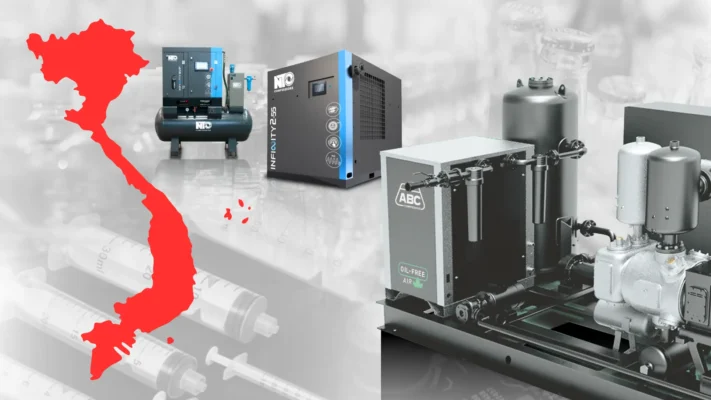
- Production capacity
- Required airflow
- Operating pressure
- Air quality requirements
- Existing compressed air infrastructure
- Energy consumption
- Future expansion plans
Solution Rather Than Brand-Oriented Selection
Different industries require different compressed air technologies. Instead of recommending a single compressor brand for every application, NTMC works with multiple internationally recognized equipment manufacturers to provide solutions that best fit each customer’s production environment. This approach allows manufacturers to select equipment based on:- Process requirements
- Operating pressure
- Air purity
- Energy efficiency
- Reliability
- Maintenance strategy
- Total lifecycle cost
Engineering Services Available
NTMC supports manufacturers through services including:- Compressed air system design
- Equipment selection
- Air demand analysis
- Energy efficiency assessment
- Installation and commissioning
- Preventive maintenance planning
- System optimization
- Technical support and troubleshooting
Key note:
The right industrial air compressor solution is determined by engineering analysis, production requirements, and lifecycle performance—not by pressure rating or equipment brand alone.
FAQ
What is the difference between a high pressure air compressor and a low pressure air compressor?
- A high pressure air compressor is designed for applications such as PET bottle blowing, pressure testing, and specialized manufacturing. A low pressure air compressor is generally used for automation, conveying, packaging, and other industrial processes requiring higher airflow at lower operating pressure.
Are rotary screw air compressors suitable for continuous production?
- Yes. Rotary screw air compressors are widely used in industrial manufacturing because they provide stable airflow, high efficiency, and reliable operation during continuous production.
When should manufacturers choose oil-free compressed air?
- Oil-free compressed air is recommended whenever air purity directly affects product quality, particularly in food, beverage, pharmaceutical, electronics, and medical manufacturing.
Should manufacturers choose higher pressure to prepare for future expansion?
- Not necessarily. Compressors should be selected based on actual operating requirements and realistic future growth plans. Oversized systems often increase energy consumption without improving production efficiency.
Why is engineering assessment important before purchasing an air compressor?
- An engineering assessment evaluates airflow demand, operating pressure, air quality, energy consumption, and future production needs. This helps manufacturers select the most suitable compressed air solution while avoiding unnecessary operating costs.
Key takeaway
Choosing the right air compressor involves much more than comparing pressure ratings. Manufacturers should evaluate production requirements, airflow demand, air quality, energy efficiency, and lifecycle operating costs before deciding between a high pressure air compressor and a low pressure air compressor. While rotary screw air compressors remain the preferred solution for many industrial applications, some industries also require oil-free compressed air to meet product quality standards. By adopting an engineering-first approach, manufacturers in Binh Duong, Ho Chi Minh, and Dong Nai can build compressed air systems that deliver reliable performance, lower energy consumption, and sustainable long-term productivity.NGHI TIN MACHINERY
- Head Office: 8 Bis National Route 13, Binh Hoa Quarter, Lai Thieu Ward, Ho Chi Minh City
- Hotline: 0937.168.008
- Northern Branch: BT2-G1 Hoan Son Project Residential Area, Tien Du, Bac Ninh
- Hotline: 0388848333
- Website: nghitin.net
- Email: sale@nghitin.vn
Leave a Reply
You must be logged in to post a comment.