
 Home
Home About Us
 Services
 Products
 Activities
 News
News Contact
Set Up Air Compressors 2026: What Manufacturers Need to Know
Setting up air compressors systems correctly from the beginning is essential for maintaining stable production, controlling energy consumption, and avoiding unnecessary pressure losses. In an industrial plant, the compressor should not be treated as an isolated machine. It is one part of a complete system that connects air generation, treatment, storage, distribution, and production equipment. This becomes particularly important when compressed air is used for specialized applications such as AOKI bottle blowing, high-pressure PET production, nitrogen generation, or CO₂-related processes. The right setup therefore starts with a simple question: What does the production process actually require from the compressed air system? The answer determines compressor technology, pressure level, airflow, air treatment, piping, storage capacity, controls, and future expansion requirements. For example, the AOKI catalog specifies compressed-air requirements of 0.96–0.98 MPa for machine operation and 2.0–3.0 MPa for stretch-blow molding. This illustrates why compressor selection cannot be based simply on motor power or machine size. The pressure and airflow requirements of the production equipment must be considered together.What Does Set Up An Air Compressor Mean?
To set up air compressors systems means more than installing the compressor and connecting a pipe. A complete industrial installation normally needs to consider:- Compressor selection
- Required operating pressure
- Airflow demand
- Air treatment
- Air receiver capacity
- Piping and pressure losses
- Control strategy
- Cooling requirements
- Production expansion
- Maintenance access
Key note:
Setting up an industrial compressor means designing the complete compressed air system, not simply choosing and installing a machine.
Industrial Air Compressors Working Diagram
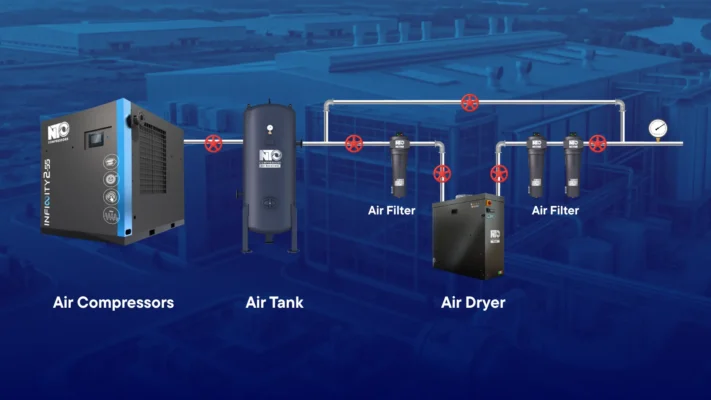
1. Air Compressors
The compressor takes atmospheric air and increases its pressure. The compressor technology should be selected according to the required pressure, airflow, air quality, and operating profile. You may want to explore the products: https://nghitin.net/en/product-categories/air-compressor/2. Cooling
Compression naturally generates heat. Cooling equipment helps control operating temperature and maintain stable compressor performance.3. Air Treatment
Depending on the application, compressed air may need:- Filtration
- Drying
- Oil separation
- Moisture removal
- Condensate management
4. Air Receiver
The receiver acts as a buffer between air generation and fluctuating production demand. It can help stabilize the system when consumption changes rapidly.5. Distribution Network
Compressed air is transported through piping to different production areas. Poor piping design can create pressure losses, increasing the pressure that the compressor needs to generate.6. Point of Use
Finally, compressed air reaches equipment such as:- Pneumatic machinery
- Packaging systems
- Automation equipment
- PET bottle-blowing machines
- Other industrial processes
Key note:
An industrial air compressor working diagram should show the entire path from air generation to the final point of use so engineers can identify pressure losses, treatment requirements, and potential efficiency issues.
Air Compressor Working Principle
Understanding the air compressor working principle is important when evaluating different compressor technologies. At its basic level, an air compressor takes atmospheric air and compresses it to a higher pressure. The compressed air then passes through cooling and treatment stages before being stored or delivered to the production process. The exact compression mechanism depends on the compressor technology. For industrial reciprocating compressors, compression takes place through cylinders and valves. ABC Compressors’ documentation describes its Horizon Synchro configuration as using double-acting cylinders with horizontally opposed cylinders and a design intended to balance forces and reduce vibration. This engineering becomes particularly relevant in high-pressure applications, where temperature management and mechanical stability are important considerations.Key note:
Understanding the air compressor working principle helps engineers evaluate compression technology, cooling requirements, pressure performance, and the suitability of a compressor for a specific application.
How to Determine the Right Compressor Setup
Before purchasing equipment, manufacturers should define the actual requirements of the production system.Required Pressure
The first question is not simply: “How much pressure can the compressor produce?” It should be: “What pressure does the production equipment actually require?” The distinction matters because generating unnecessarily high pressure can increase energy consumption. AOKI provides a useful example. Its documentation specifies approximately 0.96–0.98 MPa for machine operation and 2.0–3.0 MPa for stretch-blow molding. Therefore, a PET bottle production line using AOKI equipment needs to be evaluated according to the specific machine and process requirements.Required Airflow
Airflow demand should be calculated based on:- Number of machines
- Individual machine consumption
- Simultaneous operation
- Production cycles
- Operating schedule
- Future expansion
Air Quality
Air quality requirements vary significantly between applications. General pneumatic equipment may have different requirements from:- Beverage production
- Food processing
- Pharmaceutical manufacturing
- PET production
- Electronics manufacturing
Future Production Expansion
A compressor system should not necessarily be designed only around today’s production volume. Manufacturers should consider:- Additional production lines
- Longer operating hours
- Increased airflow demand
- New pressure requirements
- Future automation
Key note:
The right compressor setup balances pressure, airflow, air quality, operating profile, and future expansion instead of relying on horsepower as the primary selection criterion.
ABC Compressors and High-Pressure Industrial Applications
When a factory needs different compressed-air pressure levels, the compressor room should be designed around the actual production demand rather than simply installing several independent machines. ABC Compressors provides an example of this approach through its Horizon Synchro configuration. According to the ABC catalog, the system can produce high pressure, low pressure, or both simultaneously. It uses one airflow input and two airflow outputs, with automatic adaptation to production demand and frequency-converter modulation for high- and low-pressure references. This type of configuration can be relevant for factories where different production processes require different pressure levels. For example, a manufacturing plant may have:- Low-pressure requirements for general pneumatic equipment
- Higher-pressure requirements for specialized production
- Variable demand throughout the production cycle
Key note:
ABC Compressors’ Horizon Synchro demonstrates how one compressor configuration can be designed to provide high pressure, low pressure, or both, depending on production demand.
Common Mistakes When Setting Up an Industrial Air Compressor
Even a technically capable compressor can perform poorly if the surrounding system is incorrectly designed.Selecting Only by Motor Power
Horsepower or kW should not be the only selection criteria. Engineers should also consider:- Required pressure
- Airflow
- Air quality
- Operating profile
- Cooling conditions
- Production demand
Ignoring Peak Air Demand
A production line may consume different amounts of air throughout the day. If several machines operate simultaneously, peak demand can be considerably different from average consumption. The compressor system should therefore be evaluated against both current operating demand and future production requirements. ABC’s Horizon Synchro concept specifically highlights automatic adaptation to production demand and variable-speed modulation between high- and low-pressure references. Key Point: Evaluating peak demand helps prevent unstable pressure and allows the compressor system to operate more efficiently as production conditions change.Underestimating Pressure Losses
Pressure can be lost through:- Filters
- Dryers
- Valves
- Fittings
- Long piping
- Undersized distribution lines
Poor Compressor-Room Conditions
The compressor room also influences system performance. Adequate ventilation, cooling, maintenance access, and suitable installation conditions should be considered during the design stage. For a PET production environment, AOKI’s catalog shows that the compressor is only one element within a wider auxiliary-equipment arrangement that can include a dehumidifying dryer, mold chiller, cooling tower, and other equipment.Key note:
Compressor-room design should consider ventilation, cooling, maintenance access, and the other equipment connected to the production process.
How to Set Up Air Compressors Systems More Efficiently
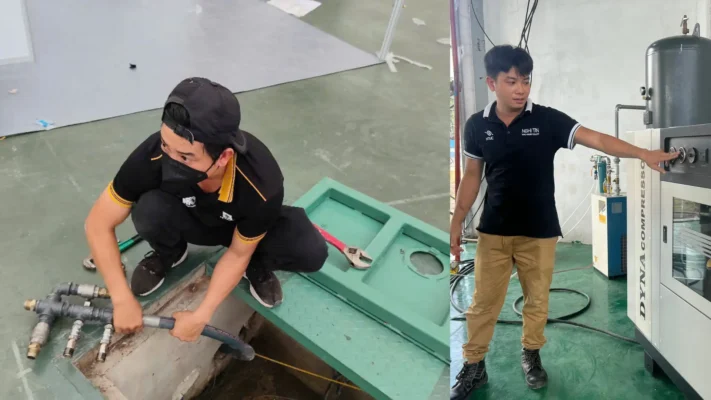
Step 1: Understand the Production Process
Identify every machine that consumes compressed air and determine its operating requirements.Step 2: Establish Pressure Requirements
Separate low-pressure, medium-pressure, and high-pressure applications where necessary.Step 3: Calculate Airflow Demand
Evaluate average consumption, peak demand, operating schedules, and future expansion.Step 4: Define Air Quality
Determine whether the application requires filtration, drying, oil-free air, or other treatment.Step 5: Select Compressor Technology
Compare suitable compressor configurations based on the actual application rather than equipment power alone.Step 6: Design Air Treatment and Storage
Determine the appropriate dryers, filters, receivers, and condensate-management equipment.Step 7: Design the Distribution Network
Minimize unnecessary pressure losses and ensure compressed air reaches the point of use at the required pressure.Step 8: Commission and Measure
After installation, system performance should be checked under actual operating conditions.Key note:
An efficient set up air compressors project follows a structured process from production analysis and compressor selection through installation, measurement, and optimization.
How Nghi Tin Supports Industrial Air Compressors Setup
For manufacturers, compressor installation is only the beginning of the system lifecycle. Nghi Tin Machinery (NTMC) can support customers through the engineering stages required to establish a compressed-air system, including:- Application assessment
- Air-demand analysis
- Compressor selection
- System configuration
- Installation
- Commissioning
- Preventive maintenance
- System optimization
Key note:
Nghi Tin’s engineering approach focuses on matching compressor technology and system configuration to the manufacturer’s actual pressure, airflow, air-quality, production, and maintenance requirements.
FAQ
What does set up an air compressor mean?
- It refers to planning, selecting, installing, commissioning, and maintaining a complete compressed-air system based on production requirements.
What should an industrial air compressor working diagram include?
- It should normally show the compressor, cooling, air treatment, storage, distribution piping, and final points of use.
Why is the air compressor working principle important?
- Understanding the air compressor working principle helps engineers evaluate how compression, cooling, pressure, airflow, and system components interact.
What pressure does AOKI bottle blowing require?
- According to the AOKI catalog, its machines require approximately 0.96–0.98 MPa for machine operation and 2.0–3.0 MPa for stretch-blow molding. Exact requirements should be checked against the specific machine and production configuration.
Can ABC Compressors supply both high and low pressure?
- ABC’s Horizon Synchro catalog describes a configuration capable of producing high pressure, low pressure, or both simultaneously, with one airflow input and two airflow outputs.
Can N2 compressors or CO₂ systems be included in the same project?
- They can be evaluated as part of a broader gas-system project, but their specifications cannot be assumed from a conventional compressed-air requirement. Gas flow, pressure, purity, temperature, and process conditions must first be established.
Key takeaway
A successful set up air compressors project starts with the production process and ends with a properly measured and maintained system. Manufacturers should evaluate pressure, airflow, air quality, peak demand, distribution losses, and future expansion before selecting equipment. ABC Compressors provides high- and low-pressure compressor solutions, including the Horizon Synchro configuration designed to adapt to production demand. For AOKI bottle blowing, the manufacturer’s documentation shows distinct compressed-air requirements for machine operation and stretch-blow molding, demonstrating why application-specific engineering is essential. For specialized applications such as N2 compressors and CO2 retriever systems, the complete gas process must be assessed before equipment is specified. This engineering-first approach helps manufacturers build compressed-air systems that are reliable, efficient, maintainable, and aligned with actual production requirements.
NGHI TIN MACHINERY
- Head Office: 8 Bis National Route 13, Binh Hoa Quarter, Lai Thieu Ward, Ho Chi Minh City
- Hotline: 0937.168.008
- Northern Branch: BT2-G1 Hoan Son Project Residential Area, Tien Du, Bac Ninh
- Hotline: 0388848333
- Website: nghitin.net
- Email: sale@nghitin.vn
Leave a Reply
You must be logged in to post a comment.